Showing posts with label Newspapers. Show all posts

Thursday, 7 June 2018

June Mock Revision - Q2

Component 1B

Question: Explore the ways in which production, distribution and circulation have shaped the newspapers you have studied. Make reference to The Daily Mirror and The Times. [15]
  • James Curran & Jean Seaton 
    • Conglomeration
      • The media is controlled by a small number of companies primarily driven by the profit and power. Media concentration limits variety, creativity and quality. More social diverse patterns of ownership can create more varied and adventurous media productions.
  • Sonia Livingstone and Peter Lunt
    • Regulation
      • The increasing power of global media corporations, together with the rise of convergent media technologies and transformations in the production, distribution and marketing of digital media, have placed traditional approaches to media regulation at risk.
  • David Hesmondhalgh
    • The Cultural Industries
      • Media producers try to minimise risk and maximise audiences through vertical and horizontal integration, and by formatting their cultural products (eg. through the use of stars, genres and serials)

Trinity Mirror owns Daily Mail and recently has been rebranded as 'Reach'.

  • Production
    • The process of making a media product. Every industry has its own forms of production.
  • Distribution
    • The process of making a media product available to audiences so that they can consume it, which includes aspects of marketing such as creating an advertising campaign.
  • Circulation
    • A count of how many copies of a media product are distributed. This can include physical distribution and subscription.
Daily Mirror is a tabloid and The Times is a broadsheet, the main difference between the two is the size of the newspapers, tabloids are more popular than broadsheets.

Broadsheets are easier to understand with middle class citizens, as the broadsheets used jargon and assumes the audience will understand the current events and the 'slang' used as it is more of a formal upper class speech.

Daily Mirror costs 50p
The Times costs £1

The price difference between the tabloid and broadsheet is double, so more middle class citizens would buy The Times due to cultural capital.

Daily Mirror is left-wing and follows the labour party.
The Times is right-wing and follows the conservative party and is owned by Rupert Murdoch.

  • Technological Change
    • Newspapers circulation is decreasing as more news is becoming available for free on websites so everyone is viewing the news for free on websites rather than going out and buying a newspaper.

Print-Based Media vs Online Media
  • Print Based Media
    • Disadvantages
      • Inconvenient, have to leave your house.
      • Generational issue (new generation isn't buying print based media)
      • Can only see one opinion
    • Advantages
      • Can be seen anywhere, no battery no wifi.
      • Employs much more people than Online Media.
  • Online Media
    • Disadvantages
      • Need internet to read.
      • People get made redundant as they dont need as many people.
    • Advantages
      • Can see many opinions in the comments section of a post.
      • Allows newspaper producers to target people who do not normally buy newspapers.
IPSO regulate the newspapers, IPSO is not fit for purpose, and they can twist the rules and get away with it especially when it comes to online media. The comment section will not be regulated as citizens will use offensive comments that are discriminating others, yet they will get away with it as it is all online.

15 MARKS

Thursday, 4 January 2018

Newspaper Unit: Audience Responses

Audience Responses

  • Ideologies of Christmas
    • Family
    • Christmas Dinner
    • Birth of Jesus
  • Stuart Hall - Reception Theory
    • The ways in which the audience process the ideologies of the producer.
  • 'P.N.O'
    • Preferred
    • Negotiated
    • Oppositional
  • Preferred Reading
    • Birth of Jesus and be involved in going to church Christmas Eve.
    • Everyone loves Christmas.
    • Joy of giving gifts.

Cambridge News Facts

  • Local Tabloid
  • Genre
  • 'TOO CLEVER FOR PRISON'
    • Were not supposed to like her and have passion towards her.
    • We feel distrust towards the court system as they are giving someone freedom for a crime which shouldn't be dismissed due to her career choice and qualifications.
    • The picture used makes us dislike her even more as she looks smug in the photo used so we dislike her even more.
    • The representations of people with mental health issues is that they may be dangerous, out of control, another stigma with mental health issues is that they don't exist, and they're just an excuse to get away with things because they cannot control their 'mental health issues'.
    • Women are hysterical
    • They mentioned that they met on tinder.
    • Oppositional - She is the victim as nobody has helped her with her mental health issues.

Tuesday, 12 December 2017

Power and Media Industries - James Curran and Jean Seaton

Power and Media Industries - James Curran and Jean Seaton


  • 'Diversity is in the public interest - but modern societies suffer from collective attention deficit disorders[...] the public interest has to work harder to be noticed, and we need agile but resourceful media to do that.' - James Curran and Jean Seaton
    • In this day in age, we get distracted by our phones, and constantly check them throughout the day, it is digital technology, they in which have connection to the wifi therefore resourceful, attracting the audience.
  • Monopoly - The exclusive ownership or control of something.

Who owns UK newspapers?


  • Conglomerate - a large corporation consisting of multiple smaller companies.
  • Subsidiaries - a smaller company owned by a large corporation.

Curran and Seaton on Monopoly

  • Advantages to forming a Monopoly
    • reduces competition
    • audience manipulation
    • 'It [extends] their range of business and political connections, [increases] their corporation's prestige and, through audacious editoral appointments, [contributes] to the maintenance of public opinion favourable to private enterprise.' - James Curran and Jean Seaton 
    • It is essential to remember that conglomerate are primarily driven by the logic of profit and power.
  • Issues with conglomeration
    • Not much diversity
    • Make their products look great
      • e.g News Corp own 20th Century Fox and The Sun so when 20th Century Fox release a new movie they'll use the Sun to give it good 'fake' reviews.
  • Key Facts with conglomerates and monopoly
    • Having a monopoly means domination of multiple media industries
    • If the focus on creating profit, generally conglomerates dont take risks with the media products that they produce.
    • This often results in limited variety, creativity and quality.
  • 'Anti-monopoly media regulation is needed not only to maintain fair competition but also to prevent the distortion of democracy.' - James Curran and Jean Seaton 

 What are the alternatives to conglomerate ownership?
  • Partnership opposed to ownership
  • Limit on how many companies you can own
  • Boycott
  • Make our own media
  • 'Media policy should seek[...] to create the conditions of greatest possible competition, thus enabling consumers to exercise sovereign control. This produces media that people want, a wide range of choice, and media independence from government.' - James Curran and Jean Seaton
  • Independent Producer
    • free from outside control
  • Institution
    • A media industry with its own identity. 
  • Industry
    • The whole media industry

Friday, 24 November 2017

Representation Paragraph

Scantily-clad women's sizzling selfies are overshadowed by their very messy backdrops.

(P) The media product is focusing on the representation of teenage girls, these teenage girls are posting 'racy' selfies online but there is more focus onto their messy bedrooms rather than the actual photo's they have posted. (E) The technical devices that the producer uses in order to present this group is the large amount of images and captions. The article uses 22 pictures all of which are captioned which is conventional for a media product however, there is less dialogue in the article than expected, perhaps aiming this to a more working class demographic through the fact that they have a shorter attention span. The mode of address used in the article is more of a patronising tone to the audience, saying 'These pictures are guaranteed to make you think twice before sharing a selfie online.' (A) The message this brings across to the audience is that this is an extremely embarrassing thing to do, and that these girls are perhaps seen as a 'disappointment' to society meaning the impact this has on the audience is that they do not want to feel embarrassed, maybe telling them to get their life's together.  This constructs a representation that the girls presented are messy and more worried about being sexualised than sorting themselves out.


Extra Notes
  • 'Scantily-Clad Stunners' this chosen lexis is something that someone in their 50's/60's will use, perhaps suggesting that the audience is more older males.
  • These images were supposed to go to their other half perhaps (boyfriends) which unfortunately got out, but it shows that the teenage girls are messy and they're more worried about being sexualised than sorting there messy selfs out.
  • There are issues with this article that Stuart Hall's Reception theory backs up as we are not sure what reading we prefer, we don't understand how to feel about this article. It also encourages a discussion between it as we are supposed to either find these girls sexually attractive and enjoy seeing these photos of them or we are completely against it and we dislike seeing this and think that they're scummy for doing something like this. 
  • Cultivation Theory - If we carry on to look at this article and think what we think about it again and again we begin to grow our understanding of it until it turns into something completely different. 
Improvements
  • Things to include;
    • This constructs a representation that...
    • This stereotypes...
    • The audience is being manipulated by the ideology...

Tuesday, 21 November 2017

Introduction to the Times and Constructing Representation

Introduction to the Times and Constructing Representation

  • What advantages are there to a newspaper demonstrating a particular political/ideological bias?
    • System of control and power.
    • Hegemony.
    • Having an ideology means you can attract more of a target audience.
    • Helps to be part of your identity.
    • To gain the support of a political party.
    • Our ideas are challenged and this is repeated over and over again.
  • Whats the difference between a Tabloid and a Broadsheet?
    • Tabloid is more gossip whereas Broadsheet is 'actual news'.
    • The Daily Mirror is aimed at working class people.
    • Less eye catching images in the broadsheet compared to the Tabloid.
    • The tabloids slang term is 'a red top' as they have red titles, and broadsheet is known as the 'serious press'. 
    • The headlines on the Tabloid are larger than the Broadsheet.
    • The level of literacy is below GCSE level to read the Daily Mirror (Tabloid) whereas the level of literacy is above GCSE to read The Guardian (Broadsheet).
    • Broadsheet has a story on the front page, apart from the masthead and above it just looks like the inside of a normal newspaper.
    • Broadsheet's are much more expensive than Tabloids which gives an idea of the income of their target audience of the higher social groups.


Polysemy - Polysemic

  • Polysemy
    • Not everything has a single meaning. One of the best ways of applying Media Theory, is through suggesting two or more possible meanings.
    • In creating a newspaper, producers typically attempt to avoid polysemic readings. The process of forcing an audience in to a particular reading is called anchoring.
  • Anchorage 
    • The 'fixing' of a particular meaning to a media text, often through the use of captions.
  • Taking inferences from a un captioned image.
    • Strength, Anger, Power, Hope, Unity. 


The Sun - Right Wing VS. Morning Star - Left Wing (Communist)


  • The Sun is going for a slating the opposition approach, not saying what good conservatives will be, but rather what bad the labour party will be. Whereas, the Morning Star say how good the labour party will be and dont mention the conservatives.
  • The Sun also use mise-en-scene to portray their ideas of Corbin as they have set him in a dirty council housing street and placed him in the bin.
  • The Sun is also using direct address towards the audience saying 'we've had enough' they've positioned the audience into the text and in a direct mode of address.
  • 'Terrorists Friend' shows the key information and the main point of the back story.
  • Morning Star is much more positive.
  • They both use the bullet points.
  • In the Sun he is looking quite shifty and looks silly whereas in the Morning Star he is looking happy and good.
  • Heroic language through the Morning Star's language.
  • The sun is a very blunt and brutal.
  • The sun has gone to an effort to make sure that he is seen horrible and brutal through words and choice of image whereas the Morning Star is portrayed that they haven't actually tried to hard and they've still managed to make him seem good.

Bias and Agenda

  • Bias
    • You favour one opinion over another when you are biased.
  • Agenda
    • Trying to do something with your opinion, doing something for a reason.
Discourse Analysis - How to Assess Bias
  • Bias through selection and omission.
  • Bias through placement.
  • Bias by headline.
  • Bias by photos, captions and camera angles.
  • Bias through use of names and titles.
  • Bias through statistics and crowd counts.
  • Bias by source control.
  • Bias through word choice and tone.

Friday, 17 November 2017

Ideology and Representation

Ideology and Representation

  • Newsworthiness
    • The process of selecting which stories to include in the paper.
  • 'If it bleeds it leads'
    • If its about gory/death then it will probably make the front page over something else.
  • Broadsheets
    • The larger style of newspapers. The content within will be a more formal writing, targeting a middle class audience.
  • Tabloids
    • These tend to focus on the working class audience by being quite informal with their stories.
  • Intertextuality
    • Where a media product makes sense only through its reference to the other media products.
    • Barthes also referred to this process as referential codes. 

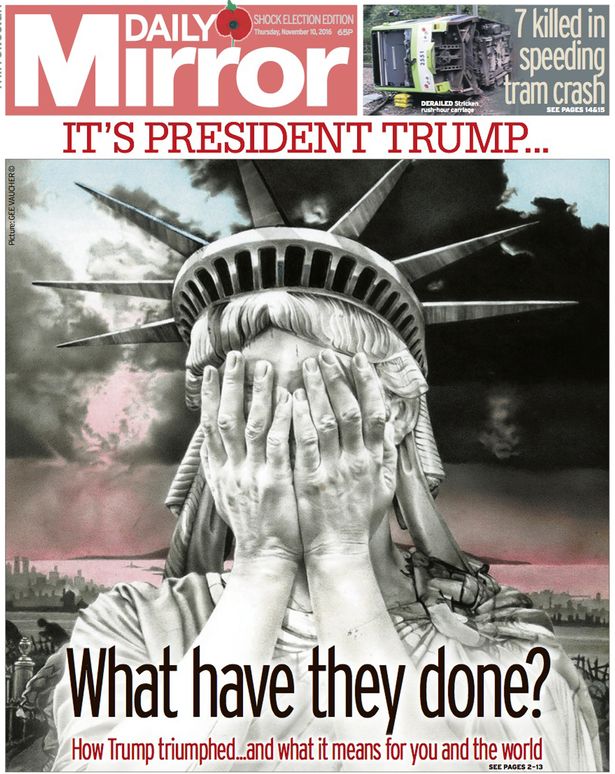
  • Statue of Liberty symbolises hope, liberty and mainly America.
  • The Statue of Liberty also looks like the weeping angels from Dr Who.
  • The Daily Mirror's ideological perspective on Trump is that he is going to ruin the world and that it is not good that he has become the USA's prime minister.
  • The setting that it is taken in looks like smoke, fire and bombs, this suggests that these are what trump wants to do and the Daily Mirror also expect us to know that these were trumps views.
  • The sky also looks like a biblical apocalypse. Also, the background looks like the next world war or Dday.
  • The statue has her hands over her face, it is symbolic as she is ashamed in her country.
  • '7 killed in speeding tram crash' - Includes the word speeding, to make it seem more disastrous and exciting. Example of 'if it bleeds it leads'.

Opinions on Newspapers

  • 'Newspapers are politically biased'
    • I agree, that if the newspaper has beliefs they will channel their ideologies through their newspapers.
    • Tv is A Political, meaning that they will not have one belief there will always be different beliefs, but they never come to a consensual agreement.
    • American TV news is incredibly politically biased.
    • English newspapers are politically anti-trump as we are anti-trump as a country, so we have biased news but completely unbiased press.
  • 'Newspapers generally appeal to older audiences'
    • yes, because we are more modern with technology so we will find the news on our phones rather than finding the news through newspapers.
  • 'Newspapers tend to offer a very negative view on the world'
    • People are fascinated by the awful and sad stories.
    • In films people die as we are drawn and react to negative things like people dying.
    • Also, the phrase 'If it bleeds, it leads'. 


Ideology

  • The producer will encode their ideologies to a text. 
  • A system of ideals and beliefs
  • But often used to describe the ways which those in power use their power to distort meaning. 
  • And ideology can be used to normalise the dominant ideas of the ruling class.

Left and Right Wing Politics Ideologies

  • Left Wing (Labour)
    • Generally a more liberal and forward-moving ideology.
    • The left on the other hand is more keen to reduce the gaps in society between the rich and the poor. They believe society should work together to help everybody, with schemes like the NHS, Benefits and Free Education. They argue the rich should pay for this through taxes, thus reducing the gap between rich and poor.
    • To do this, economically, they need to raise taxes. They also prefer to regulate 'the Market', which means distributing the wealth created on the stock market and in banks so that it does not all end up in the pockets of millionaires but some of it goes to the country's problems.

  • Right Wing (Conservatives)
    • More conservative and generally traditional. 
    • On a social level, the right generally believes that a hierarchy in society is natural and normal. For them, the idea of a class system whereby the richer employ the poorer in a triangle is healthy because everybody benefits and it has historically been the natural order of things.
    • Their economic policy (generally speaking) complements this, by promoting a form of capitalism which gives more economic freedom to big businesses. This means fewer regulations and lower taxes. They argue that as big businesses grow they create jobs for the working class and gradually everyone gets richer.

Thursday, 16 November 2017

Newspapers

Newspapers

  • Codes and Conventions - What makes Newspapers different from other forms of media?
    • Newspapers have large fonts (headlines)
    • Emphasis on text rather than the image's
    • Magazines usually have one large photo with text around it rather than newspapers which have many photos and many different textual connotations. 
    • Newspapers already know their audience, and they put trust in the audience knowing the things they're talking about. Assumed knowledge is used and the same in the fashion magazine, with the high end fashion labels, which would be tricky to know if you weren't high end or understood this fashion magazine. 

Key Terms and Definitions

  • Masthead
    • Title of a newspaper.
  • Barcode
    • Used to scan the newspaper when purchasing, holds information such as the price.
  • Caption
    • Brief text underneath an image describing the image.
  • Headline
    • Phrase that summarises main point of article. 
  • Main Image (Splash)
    • Dominant picture on main cover.
  • Page Numbers
    • System of organisation within the magazine so the audience knows where to find everything.
  • Target Audience
    • People who the newspaper aims to sell to.
  • Pull Quote
    • Something taken from within an article, usually said by someone on the front page.
  • Classified Ad
    • An advertisement which only uses text.
  • Skyline
    • An informational panel on the front page to tempt the audience inside.
  • Edition
    • Some newspapers print several of these every night, these are versions with some changes and may be additional late stories.
  • Stand First
    • Block of text that introduces the story.
  • Byline
    • The line above the story, gives the authors name and sometimes their job and location.
  • Body Text
    • Also known as a copy. Written material that makes up the main part of an article.
  • Standalone
    • Picture story that can exist on its own.
  • Centre Spread
    • A photograph which runs across the middle two pages.
  • Lead Story
    • Main Story, Usually a splash.
  • Gutter
    • Blank space between margins of facing pages of a publication or the blank space between columns of text.
  • Folio
    • Top label for the whole page.
  • Page Furniture
    • Everything on a page except pictures or text of stories.
  • Sell Line
    • Something that promises something inside and suggests value, that you're getting more for your money.

Key Theory's Recap

  • Claude Levi Strauss - Structuralism
    • Binary Oppositions - Where two concepts, messages or values are presented in direct opposition with one another. Levi-Strauss suggested that our perception of the world is based on binary oppositions.

    • Binary Oppositions are an element of narrative, as they can quickly tell a story, and establish characters and archetypes.
  • Roland Barthes - Semiotics
    • Symbolic Code
      • A deeper meaning within a certain text.
    • Proairetic Code
      • Also known as action codes, these refer to something within a media product that suggests that something will happen. 
    • Hermeneutic Code
      • Also known as the enigma codes, these refer to something within the media product that creates mystery and suspense. 


Deconstructing Newspapers


Tuesday, 14 November 2017

Introduction To Newspapers

Introduction to Newspapers

4 Concepts of the A-Level Media:
  • Section A
    • Media Language 
    • Representation
  • Section B
    • Audience
    • Industry
Media Institution

Institution - The values and ideology of a media production. 

Institution and Industry are completely different terms.

Long Road Website Advertising

  • The girl seems quite edgy as she has different coloured hair , this kind of shows that the college is promoting difference and the idea of freedom as the majority of high schools would've kicked you out for having different colours in your hair so it makes the sixth form seem caring for individuality and being different. Also, her quote says 'ready to be independent, to be treated as an adult shows that although they're still a sixth form that they're a big difference to high school.
  • The idea that all the students are different. Jack (Afro) is a bit edgy, and looks a bit afro Caribbean, the connotations of these people are that they are laid back, so it makes the college seem extremely laid back.
  • Josh looks very 'stereotypically' mature or nerdy, which gives connotations that he is sensible and mature, whereas Isobel looks very different and edgy.
  • By using these people, they look very different to the subjects they take, showing that you can take whatever you want and be your own person.
  • Long Road puts across the messages and values that they do to attract students and get money from the government. 
  • Differentiation
  • Competition
  • Identification
  • Ideology 

Logo's - Deconstruction / Textual Analysis

  • Shell Logo
    • Looks like the petrol gauge for your fuel level, also with the red around it, it makes drivers think that there fuel is low and that they are in need to fill up as red connotes danger or emptiness. 
    • Red and yellow symbolises fire and combustion and they will catch your attention if you see it. 
    • The red also symbolises power and royalty. 
    • The shell also looks like a sunrise so it makes you think that its a routine in the morning to go fill up at shell.
    • Sharp lines look fast.
    • 2 colours make it simple and clear.
    • Also bold and powerful.
    • Shell shaped so it shows that it is natural.
  • Starbucks
    • American - has a passing resemblance to the statue of liberty.
    • Green - Colour of money.
    • Soothing and Wavy - Solve that issue by having a coffee. 
    • Mermaid - Stereotypical to a women. 

First Impressions on Daily Mirror Newspaper Front Cover


  • More of a gossip mail rather than news and politics due to the tv shows at the top.
  • Informal as they're using slang terms like 'Corrie Claire' so they're assuming that we know who Corrie Claire is due to her being off of coronation street so they're making large assumptions to who their audience is, due to their being no context 'ITV show Coronation Street's Claire says...'
  • Informal working class gossip magazine.
  • Sensitive issues being joked about and being treated very light hearted and they're using puns, comes from boxing, so you need a lot of knowledge to understand the background of this mail.
  • Quite a lot of images, so the target audience has quite a short attendance span, so theres not much writing at all compared to photo's as they're targeting the working class demographic.
  • Daily Mirror is anti-trump, due to the choice of language. This is the dominant reading that we see this and think 'Trump is disgusting'. Daily Mirror is using dark humour and a pun, a simple source of humour, this suggests that the target audience is quite immature and working class rather than the upper more mature class. The photo used has been selected as it suggests about trump that he is sleazy, creepy and odd.

Revison - Component 2c - Online Media (2 QUESTIONS)

Question 1 How significant is the role of individual producers in online media industries? Make reference to Zoella to support your argume...